Level Designer

Wizard Tower
Wizard Tower Is a full-scale level design, and I wanted to apply everything I had gained in level design to make it memorable. I focused on using techniques like “weenies”, eye-catching elements that draw the player in with the Wizard Tower itself serving as the main visual anchor and landmark for the level. I used large directional arrows as map markers to guide players toward key objectives without the need for dialogue. To keep the journey engaging, I scattered collectible coins along paths to break the monotony of simply holding the W key, and placed additional coins in hidden or out-of-the-way spots to reward exploration. This balance of clear direction and optional discovery helped bring the level to life and made movement through the space feel more rewarding.
Teleporter Section Playthrough

In Game View
Pillars Challenge Playthrough

In Game View
The Level
At the start of Wizard Tower, I wanted to immediately give the player a clear visual goal and objective using only environmental design. Without any words, the positioning and design elements guide the player’s focus and set the stage for the journey ahead.
-
Landmark placement: (Weenie design): Implemented a "weenie" (a visual landmark) in the form of the Wizard Tower with a glowing yellow beam, drawing players naturally toward the goal.
Level Layout
.jpg)
Teleport Dock
In the teleport section, I wanted to subtly guide the player toward the puzzle mechanics using environmental cues. The player notices floating coins in the middle of the area, which sparks their curiosity, especially since they’ve already been collecting coins throughout the level.
-
Encouraging curiosity through rewards: Used floating coins as a visual lure to attract players and reinforce previously learned behaviors (collecting).
-
Feedback loop and experimentation: Encouraged players to try things out and discover solutions organically, reinforcing engagement through trial and success.
-
Reward-based progression: Reinforced learning by rewarding players (with the blue key) once they understood and completed the mechanics.
Teleport Layout
.jpg)
Pillar Challenge
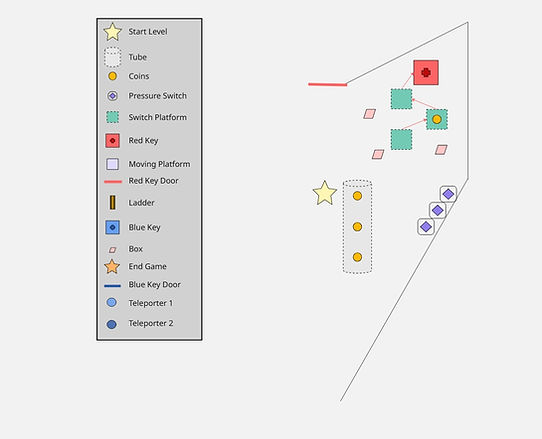
For the pillar section, I wanted to introduce a mechanic that was different from jumping and platforming, while still creating a memorable challenge to obtain one of the starter keys. The buttons were placed beneath lights to highlight their importance, and three conveniently placed cubes were provided to raise the pillars on the ground, allowing the player to reach a key positioned high in the sky.
-
Environmental cues and visibility: Initially placed buttons on brown blocks for contrast, but noticed they were still overlooked during playtesting. Introduced overhead light sources to draw attention directly to the buttons, increasing visual clarity and guiding player focus more effectively.
-
Iterative design and visual feedback: Used lighting and environmental contrast to guide players toward key interactions. This iteration improved the player’s ability to understand the puzzle intuitively and reinforced the importance of interacting with the red buttons to progress.
Pillar Layout
.jpg)